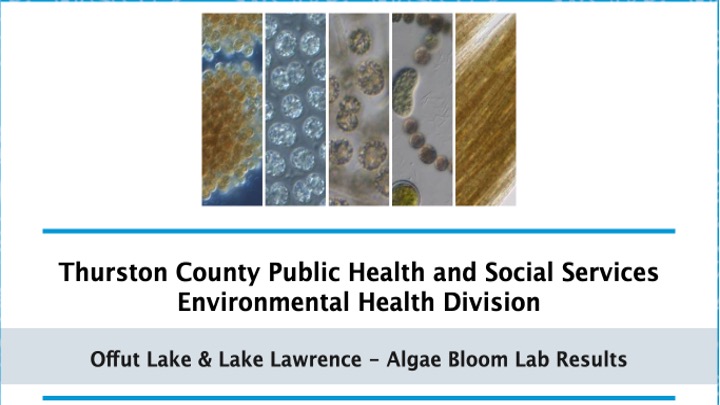
Every fall we all notice sheens of algae coming and going around our docks, on the shoreline and around the lake. Recently our lake has been above the state guidelines twice in 2025: Nov. 4, 2025, and Oct. 22, 2025. When algae is present we usually hear questions like:
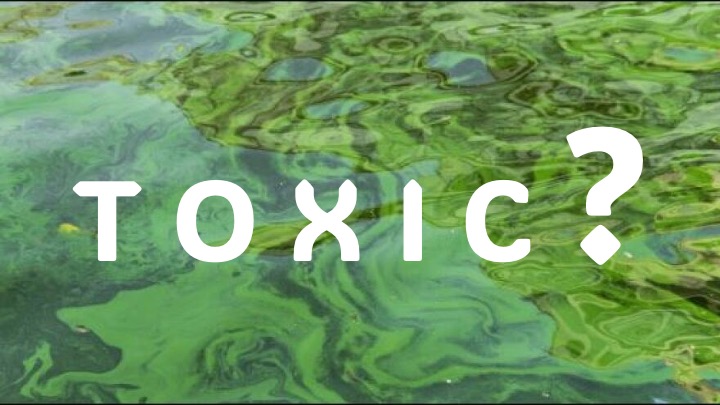
“Is it toxic algae?”
“Is it safe to swim, fish, etc.?”
“Is it harmful to pets?”
In talking with the experts, we have learned that even though many people have their own anecdotal methods, there is actually no visual or physical way to determine toxicity without a lab test. It is also important to note that not all algae is toxic. Some is beneficial for the lake and fish. The problem is that one cannot make a visual determination about the safety of the algae.
The good news is that citizens can report an algae bloom to Thurston County Public Health and Social Services Environmental Health Division and they will come, take a sample ,and publish the results. Here is a LINK to their Algae webpage and a LINK to the Freshwater Algae Bloom Monitoring Program.
If the County finds toxicity after testing, they will post Yellow or Red Warning Signs and send out an advisory email. Use this LINK to see samples of those signs.
Even better, you can sign-up to get those advisory e-mails about algae testing on Offut Lake using this LINK. In the County reports you will see the date the sample was taken, the location, and it will compare the results to the state guidelines.
This LINK shows algae testing results for Offut Lake from the present all the way back to 2011. Looking back over the years, the County has tested our lake for two toxins: Anatoxin -a and Microcystin.
Anatoxin-a
Anatoxin-a occurs naturally and may be present when a harmful algal bloom has formed on a lake, pond, or stream. Not all algal blooms contain the cyanobacteria that produce anatoxin-a. However, there is no clear way to know if an algal bloom contains harmful toxins. The most likely way for anatoxin-a to enter your body is to swallow water or inhale water spray with the toxin in it. Anatoxin-a can harm the nervous system. Swallowing water with high levels of anatoxin-a has caused death in laboratory animals, wildlife, livestock, and pet dogs within minutes to a few hours after exposure.
Microcystin
Microcystin is a toxin produced naturally by cyanobacteria, also known as blue-green algae. When excess cyanobacteria grow in a lake or pond, they form an algal bloom, which often appears as a layer of green scum. However, not all green scum on a lake is an algal bloom, and not all algal blooms contain the kinds of cyanobacteria that produce microcystin-LR. There are many types of microcystin; microcystin-LR is one of the more toxic and well-studied varieties
Summary
So, the professionals have this advice: “When in doubt, stay out!” Report suspected algae blooms and keep yourself and pets out of the water until you hear from the County that it is safe.